
A Library That Never Truly Died
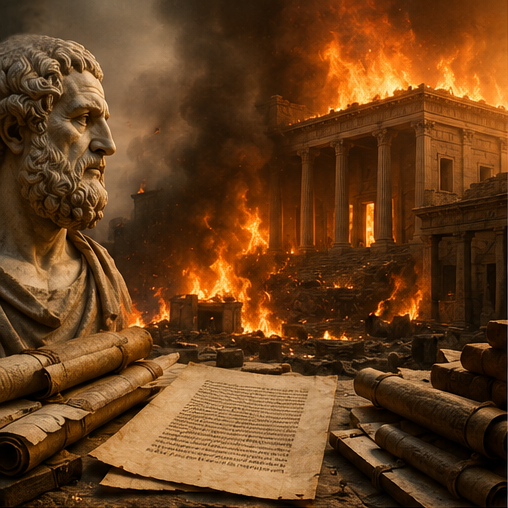
In 48 BCE, during Julius Caesar’s campaign in Egypt, a fire broke out in the port of Alexandria. The flames – according to legend – reached the world’s largest library and burned nearly half a million scrolls: Aristotle’s lost dialogues, long-forgotten dramas, astronomical observations, medical descriptions. Fragments of an entire civilization’s thinking were destroyed in a single night. Or were they? Modern scholarship offers a more nuanced picture: the Library of Alexandria actually declined gradually over several centuries, rather than in a single catastrophic event. Yet the legend still speaks a deeper truth: what is once lost is rarely recovered. There is no better metaphor for the fragility of knowledge than a burning library.
Two thousand years later, as librarians, we are working in a moment that future generations – if we are fortunate – may identify as a turning point in the history of memory. If we are not, it may be remembered as an anonymous chapter of the “digital dark age.”
The Question of the Archaeologist
Let us imagine an archaeologist 3,000 years from now. What will they find of us?
Archaeology always works with fragments. It does not reconstruct what once was, but what has survived – and the difference between the two is enormous. Mesopotamian clay tablets from the 3rd millennium BCE survived because fires that destroyed libraries accidentally baked and hardened the clay. Egyptian papyri survived due to the dry desert climate; in the humid soils of Europe, they would have decomposed within centuries. Some medieval codices survived because generations of monks repeatedly copied them, deliberately transferring knowledge into the next era.
Survival was never natural. It has always been the result of active decisions – whether deliberate or accidental.
Our digital civilization, by contrast, simultaneously produces the largest amount of data in history and creates one of the most fragile infrastructures of memory. In 2015, Vint Cerf, one of the architects of the internet, warned of what he called a “digital dark age”: a future in which vast amounts of
21st-century documents, images, videos, and correspondence may become inaccessible because software, file formats, and hardware evolve faster than our ability to preserve them.
A 1990 WordPerfect file may no longer open directly in modern word processors; in many cases, it can only be accessed through conversion or specialized tools. Will today’s DOCX files be readable in twenty years? A Spotify playlist, a deleted Instagram post, an expired cloud storage account – these may become as inaccessible to future archaeologists as a baked Assyrian clay tablet is to us.
Alexandria Has Burned More Than Once
The true lesson of the Library of Alexandria is not the fire, but the process. The library declined over centuries: political neglect, loss of funding, and the shifting center of the empire all contributed to the gradual disappearance of what was once the intellectual hub of the Mediterranean world.
Modern analogies are strikingly familiar. GeoCities – the early internet’s most important community space, where the first generation learned what it meant to share oneself publicly – was shut down in 2009. Nearly 40 million websites, an entire digital subculture, disappeared overnight because maintaining the service was no longer considered worthwhile. When Yahoo Answers closed in 2021, an entire culture of question-and-answer interaction disappeared with it. The fragments that remain are accessible only thanks to the work of the Internet Archive.
Today, cultural memory is endangered not by spectacular destruction, but by more prosaic technical and economic processes: server maintenance costs, format obsolescence, and changing business models. The result, however, may be the same.
What Does a Library Preserve – and How?
Libraries are humanity’s oldest and most reliable memory systems. Not by chance: institutional preservation is based on ensuring that survival does not depend on a single person’s decision, a single building’s fate, or a single era’s interests.
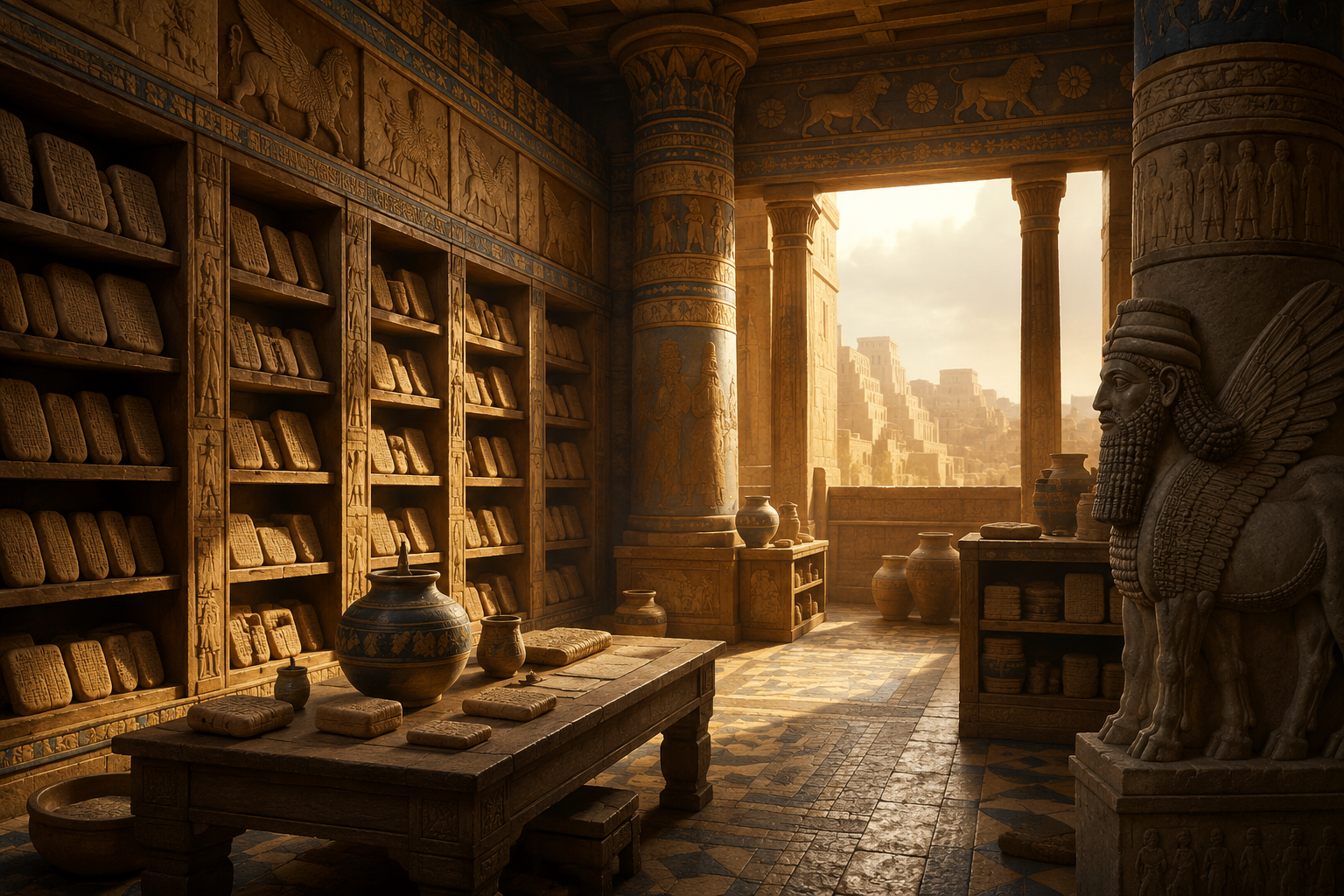
The Library of Nineveh – Assurbanipal’s 7th-century BCE Assyrian collection – preserved over 30,000 clay tablets containing the knowledge of its time. It survived because clay tablets are physically stable storage media, and because the library functioned within an institutional framework. The Ebers Papyrus, one of ancient Egypt’s most important medical texts, survived because at some point people decided it was worth preserving. The Bodleian Library in Oxford still safeguards more than 13 million volumes because it has operated continuously since its foundation in 1602.
Continuity is the key. Not a single perfect moment of preservation, but a repeated decision: this is worth saving.
In the digital age, this task has become far more complex, because it is not enough simply to store something. One must continuously ensure that storage media are replaced before obsolescence,file formats are migrated in time, and metadata – without which content may become unintelligible – are preserved.
Digital data loss is caused not only by technological obsolescence. Most data today no longer reside on physical media but in cloud infrastructures, where risks have changed in nature. The threat is often not hardware decay, but lack of maintenance, business decisions by providers, or even geopolitical conflicts.
One widely adopted response is the 3-2-1 backup rule: at least three copies, on at least two different types of storage, with at least one copy stored offsite – potentially in another building, city, or country.
Another challenge is format migration: it is often not enough to preserve a file; the entire software environment in which it was created and interpreted must also be preserved, which requires significant resources. Digital preservation is therefore not a one-time archiving process, but continuous, conscious, and multilayered care.
Open Science as a Memory Infrastructure
The principle is simple: where legally, ethically, and professionally possible, research data, methods, and publications should be accessible to all and preserved in the long term.
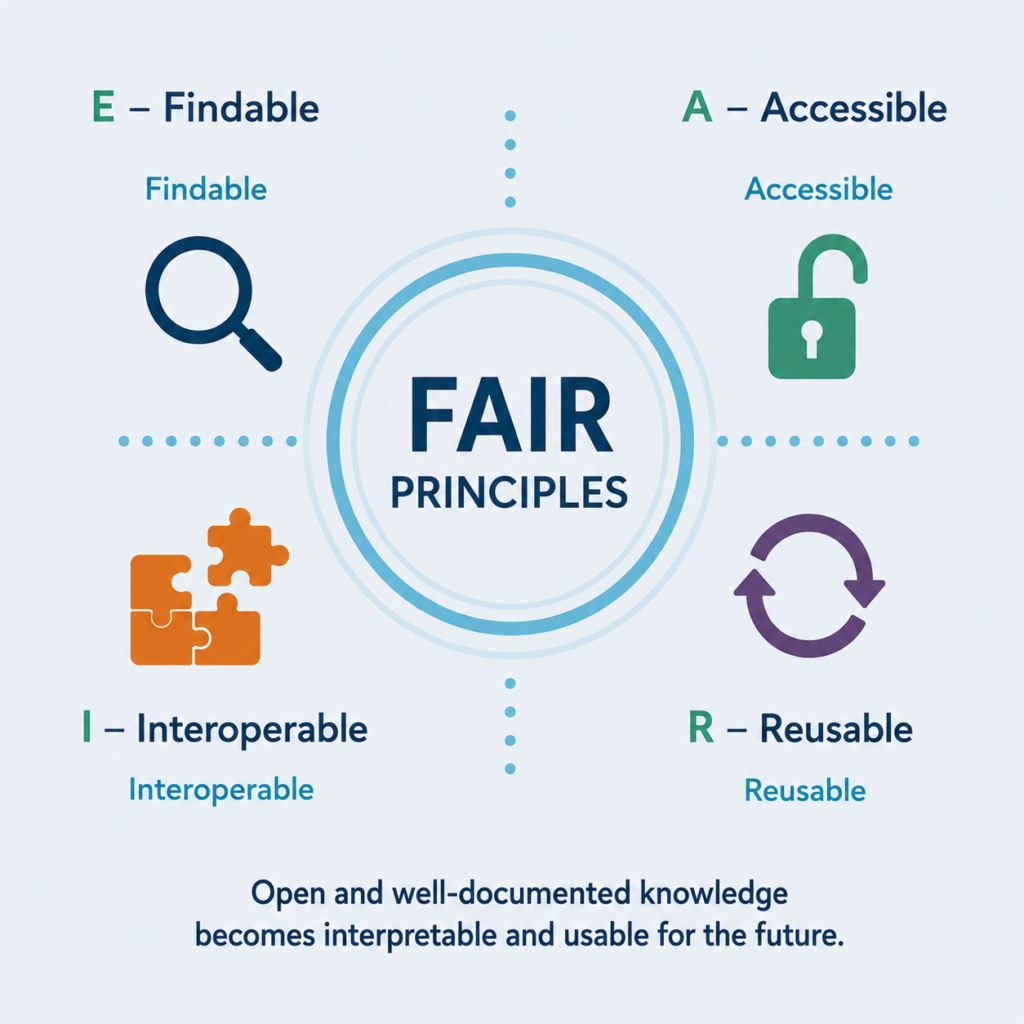
The FAIR principles (Findable, Accessible, Interoperable, Reusable) serve not only scientific reproducibility. A dataset documented and stored according to FAIR principles leaves behind a context that is interpretable for future generations, unlike a closed, proprietary system without metadata, which will likely become unreadable in 30 years.
The decipherment of Linear B by Michael Ventris in 1952 demonstrated that a civilization’s memory can outlive the civilization itself if information is recorded with appropriate medium and context. The Mycenaean tablets provided sufficient clues because they were economic records: repetitive structures, recognizable patterns, and contextual consistency. Our research data will be interpretable in the future if they are similarly structured, documented, and accessible.
The Role of the University of Pécs Library: Time Capsule Builders in Pécs
The University of Pécs Library and Knowledge Centre participates in this knowledge-preservation work, often invisibly, behind the scenes, but with long-lasting impact.
DOI Office
 Persistent identifiers such as DOI and ORCID are fundamental building blocks of digital preservation. A URL may change, a platform may disappear, but a properly maintained DOI will still point to the correct content even if the original website no longer exists. Our library’s DOI office, as a contractual partner of the CrossRef agency, provides such identifiers for university publications: journals, books, conference proceedings. The library supports authors’ scholarly publishing activities by making their work discoverable and citable, now and in the future.
Pécsi Egyetemi Archívum (PEA)
 Publications with DOIs are also deposited in an institutionally managed repository, the Pécs University Archive (PEA), which functions as a stable, searchable, and institutionally protected “digital clay tablet,” ensuring long-term accessibility and standardized metadata services.
University Journal Platform
 The OJS-based platform available under PTE Journals offers a free and professional solution for scholarly journals. It allows the entire publishing workflow – from manuscript submission to publication – to be managed in a single system. Thanks to its features and the use of DOI identifiers, published articles can be more easily indexed in databases, making them more widely discoverable and accessible. This helps journals integrate more effectively into international scholarly communication.
Why ISBN Matters?
An ISBN is an international, unique identifier that designates a specific edition of a book or book-like publication. It supports cataloging, library processing, distribution, and citation.
ISBNs can be assigned to printed and electronic books, audiobooks, and maps. Each distinct format (e.g., print, PDF, EPUB) receives a separate ISBN. Serial publications are identified by ISSN, and musical scores by ISMN.
Digitization
The library’s digitization activities are guided by preservation needs and user demand: analog documents and collection items are converted into digital form for long-term preservation and to make previously local-only materials open, searchable, and citable.
Digitization is the inverse of archaeological work: instead of reconstructing a whole from fragments, it preserves the whole before it becomes fragmented. However, digitization alone is not preservation; long-term accessibility requires proper archival, retrieval, and migration processes.
What Can Researchers Do?
Digital memory preservation is not only the task of librarians.To improve scholarly visibility, the following are important:
- Use persistent identifiers (e.g., DOI and ORCID), which ensure stable identification of publications and authors regardless of platform or institutional changes. DOI identifies the publication, ORCID identifies the author.
- Deposit work in repositories such as Zenodo, institutional repositories, MTMT, and European open-access platforms such as OpenAIRE, designed for long-term preservation.
- Prepare data management plans already at the research design stage, defining how data will be preserved and made accessible to as wide an audience as possible.
Each such decision is a small safeguard – like a clay tablet against the “digital fire.”
The Alexandrian Legacy
Alexandria still lives – not in its original building, but in its idea. The Bibliotheca Alexandrina, opened in 2002 at the original site, consciously carries this legacy: it is not only a library, but also a global actor in internet archiving.
Each time librarians and researchers publish openly, document datasets according to FAIR principles, or digitize historical documents, they are doing what Alexandrian scribes once did: deciding what is worth carrying forward into the next age.
We cannot know what will survive, but we do know what would guarantee that nothing survives at all: the absence of conscious decisions, institutional care, and the belief that the future has a right to know its past.
Recommended literature and sources
Alexandria and the historical role of the libraries
- MacLeod, R. (szerk., 2000). The Library of Alexandria: Centre of Learning in the Ancient World. I. B. Tauris
- Casson, L. (2001). Libraries in the Ancient World. Yale University Press
- Canfora, L. (1990). The Vanished Library: A Wonder of the Ancient World. University of California Press
Digital keepsaking and the digital dark ages
- Cerf, V. (2015). Google’s Vint Cerf warns of ‘Digital Dark Ages’. BBC News, 2015. február 13.
- Kuny, T. (1997). A Digital Dark Ages? Challenges in the Preservation of Electronic Information. IFLA General Conference Proceedings
- Mayer-Schönberger, V. (2009). Delete: The Virtue of Forgetting in the Digital Age. Princeton University Press
Open science and FAIR
- Wilkinson, M. D. et al. (2016). The FAIR Guiding Principles for scientific data management and stewardship. Scientific Data, 3, 160018. https://doi.org/10.1038/sdata.2016.18
- Koltay, T. (2016). Az adatközpontú tudományos kommunikáció és az adatmenedzsment. Könyvtári Figyelő, 62(1), 5–16
Archeology and writtings
- Chadwick, J. (1958). The Decipherment of Linear B. Cambridge University Press
- Renfrew, C. & Bahn, P. (2016). Archaeology: Theories, Methods and Practice. Thames & Hudson
Institunional and global archives:
– Internet Archive
– Bibliotheca Alexandrina
– Europeana Foundation
– OpenAIRE
– UNESCO Digital Library
Leave a Reply