
Let’s admit it: the world of lightsabers is so captivating that we rarely stop to think about the plasma physics behind them. Yet if we dig a little deeper, it becomes clear that the worlds of science-fiction films and novels have long been more than simple entertainment—they function as a kind of intellectual laboratory where “what if” questions sometimes point toward real scientific directions.
For a physics student, for example, Star Wars is not merely a sequence of spectacular battle scenes, but a constant source of questions: what aspects can already be interpreted through the tools of modern physics, and what still belongs solely to the realm of imagination?
The Lightsaber and Plasma – Where Fiction Meets Physics
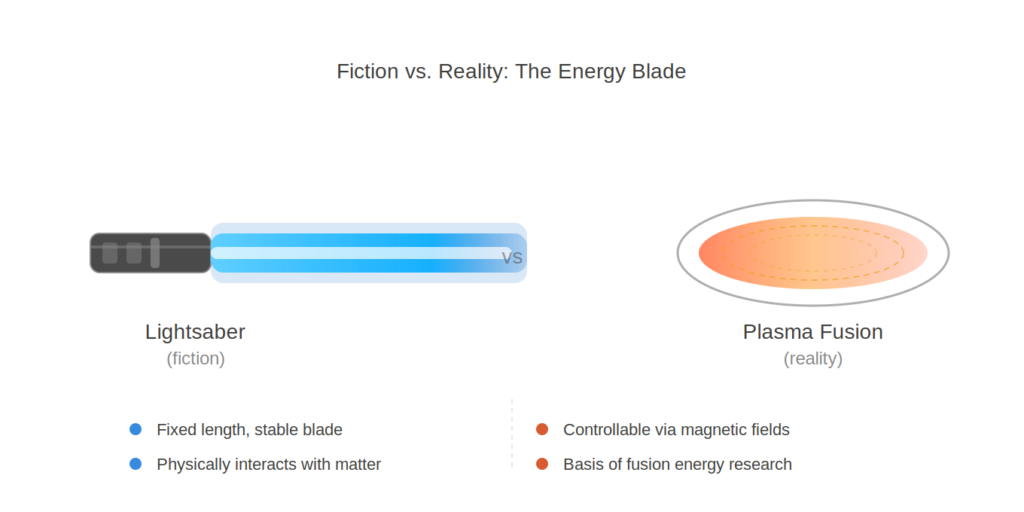
Let us begin with the most obvious example: the lightsaber. It is perhaps the most iconic “scientific” device in popular culture—and at the same time one of the most frustrating when approached from a scientific perspective.
Creating a real “energy blade” would require a medium capable of carrying enormous amounts of energy, maintaining a stable form, and physically interacting with other materials all at once. This alone presents a major challenge. The closest real-world analogy is plasma—the ionized state of matter—which, under suitable conditions, can be controlled with magnetic fields and operates at extremely high temperatures. Plasma physics, incidentally, is far from pure science fiction: fusion energy research is based on it, and scientists are already able to create partially controlled plasma beams.
The problem is that a freely “floating,” stable plasma structure resembling a lightsaber is currently impossible to achieve. The enormous energy requirements and stabilization issues reinforce each other as obstacles. Lasers do not provide a real solution either: a laser beam cannot be shaped into a finite-length “blade”; it simply passes through everything without stopping midway. So for now, the lightsaber remains where it belongs—on the movie screen.
Hyperspace Travel: Impossible Dream or Theoretical Possibility?
In the Star Wars universe, interstellar travel takes only moments. In reality, things are a bit more complicated.
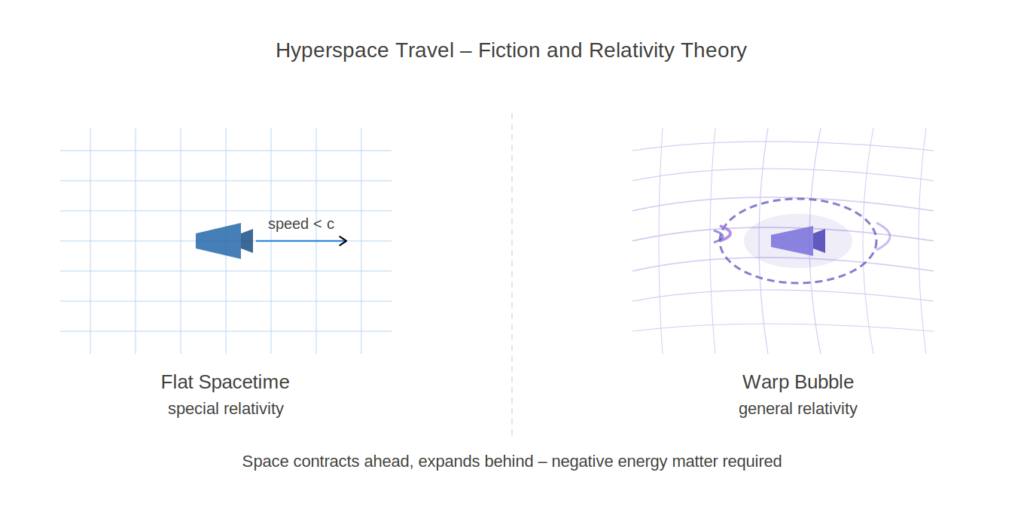
Special relativity clearly states that nothing can travel faster than light. This is not merely a technological limitation but a fundamental law of the universe. At first glance, hyperspace jumps therefore seem entirely impossible.
But—and this is where physics itself becomes exciting—the mathematics of general relativity leaves room for some intriguing loopholes. Wormholes, for example, are hypothetical structures that could connect two distant points in spacetime. The concept of warp drive would not increase the speed of movement itself; instead, it would “compress” space in front of the spacecraft and “expand” it behind.
The catch is that these remain purely mathematical models for now. Not only are we currently unable to realize them, but they would also require conditions such as negative-energy matter, the existence of which has not even been proven. Here, science fiction does not predict the future so much as pose a question on our behalf: where exactly are the limits of physics?
From Droids to Artificial Intelligence
C-3PO is fluent in more than six million forms of communication. R2-D2 can repair an X-wing fighter in the middle of battle. If we had seen these abilities on screen in 1977, they would have seemed like pure science fiction. Today… not so much.
Over the past decade, artificial intelligence research has achieved breakthroughs in fields once considered exclusively human domains: natural language processing, image recognition, and complex decision-making. Thanks to the development of large language models and neural networks, machines capable of communicating naturally with humans are becoming increasingly real.
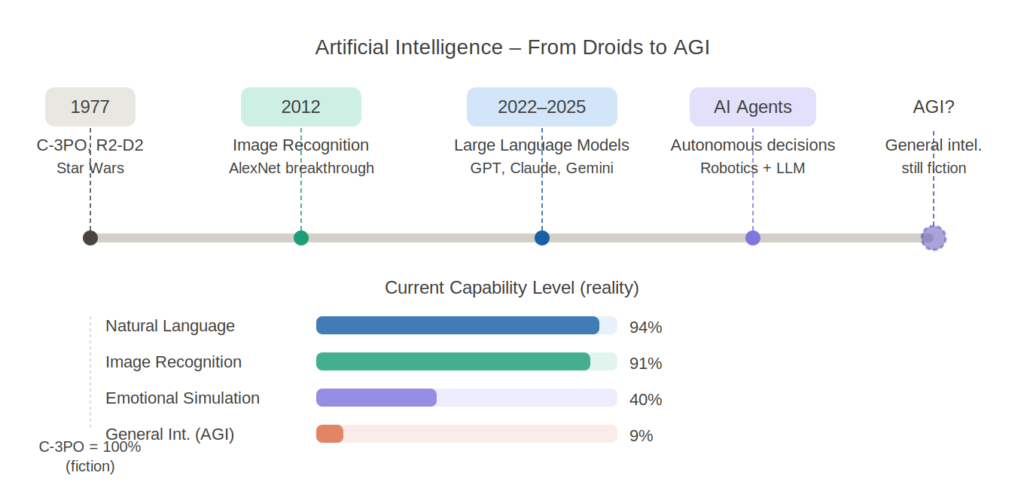
At the same time, a fully autonomous system capable of simulating emotions and possessing general intelligence—what the literature refers to as AGI, or artificial general intelligence—does not yet exist. From this perspective, C-3PO is still fiction. But perhaps not for much longer. This is the field where the inspirational role of science fiction is most tangible: many AI researchers openly state that these stories were what first inspired them as children to ask the question—what would it take for a machine to think?
Keeping up with the explosive development of artificial intelligence is no easy task, which is why our colleagues strive to provide guidance for those interested in the latest research trends and the ever-expanding world of AI through a variety of useful articles.
Through these writings, readers can also receive practical advice on the use of AI.
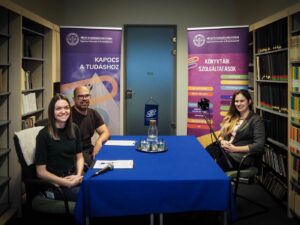
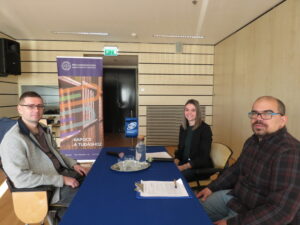 In the Kapocs a tudáshoz podcast series episode titled “Physics Is Most Similar to Building with LEGO” – A Conversation with Physicist György Tóth, listeners can gain insight into the fascinating world of physics.
During the discussion, special light pulses and science communication also come into focus.
Dune: When Science Fiction Models Ecology and Society
At this point, it is also worth turning to the universe of Dune, which—unlike Star Wars—approaches science not primarily through technological visions, but through the presentation of complex environmental and social systems.
The Hungarian connection is particularly fascinating: Gábor Lente, lecturer at the University of Pécs, has explored the scientific background of the work in several publications. His analyses point out that Frank Herbert’s world is not merely literary fiction, but a deliberately constructed scientific thought experiment.
The planet Arrakis can be interpreted as a model of an extreme desert ecosystem, where water is the most valuable resource. Although not entirely realistic in every detail, the description of the planet’s water management strongly relates to real ecological and climate-science questions: how does resource management function in a closed system, and how does the environment shape the structure of society?
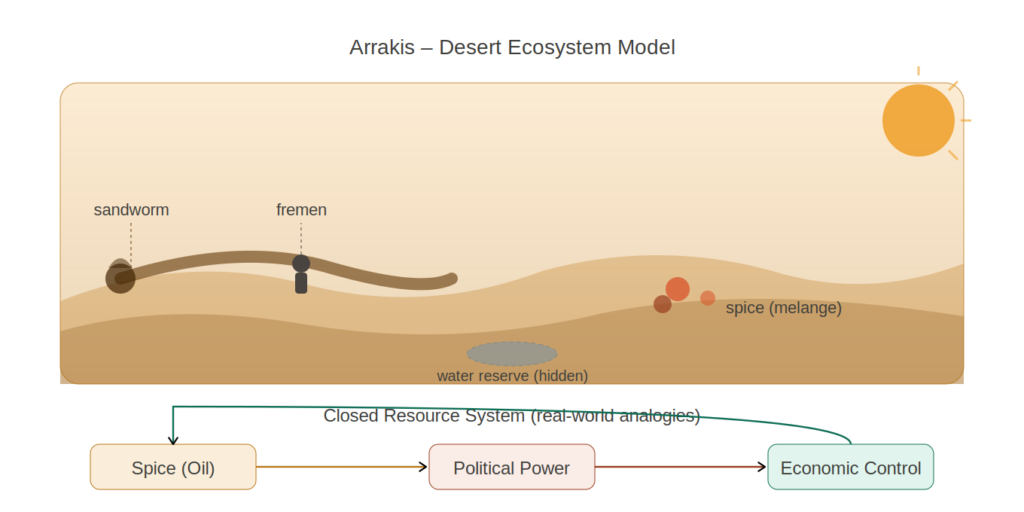
The role of the “spice” (melange) can also be interpreted from scientific and economic perspectives: it appears as a single strategic resource that determines political power relations. This model can be compared to real-world dependencies on raw materials, such as the global importance of energy resources.
Gábor Lente also emphasizes that science-fiction works—especially Dune—are significant from the perspective of science communication. These stories can build bridges between general audiences and complex scientific concepts: abstract physical, chemical, or ecological phenomena become easier to understand and experience through narrative.
This approach is reflected in the volume Beyond Space-Time: Studies on Our Favorite Universes, co-authored by Hungarian researchers, which examines several popular science-fiction universes from a scientific perspective.
Scientific popularization today is no longer confined to books. Gábor Lente’s lectures and online content provide opportunities to better understand the scientific principles underlying science-fiction worlds. Such initiatives are especially important for reaching younger generations, for whom popular culture—such as the newer Dune film adaptations or the television series The Big Bang Theory—often represents the first point of connection to science.
Dune is therefore not merely a classic science-fiction work, but also a complex model in which the interactions between environment, society, and economy appear simultaneously. This
 systems-level way of thinking is particularly valuable from the perspective of contemporary scientific research.
For those interested in legal questions arising from interstellar law and the space race, our podcast discussion with legal scholar Dr. Zsófia Bíró may provide valuable insights.
Interaction – Imagination and Science
For us, it is important that interdisciplinary topics reach as wide an audience as possible. Science-fiction literature is more than light entertainment: it is one of the most creative workshops for thinking about the future.
These stories help us imagine what does not yet exist—and by doing so, they may contribute to making it reality one day.
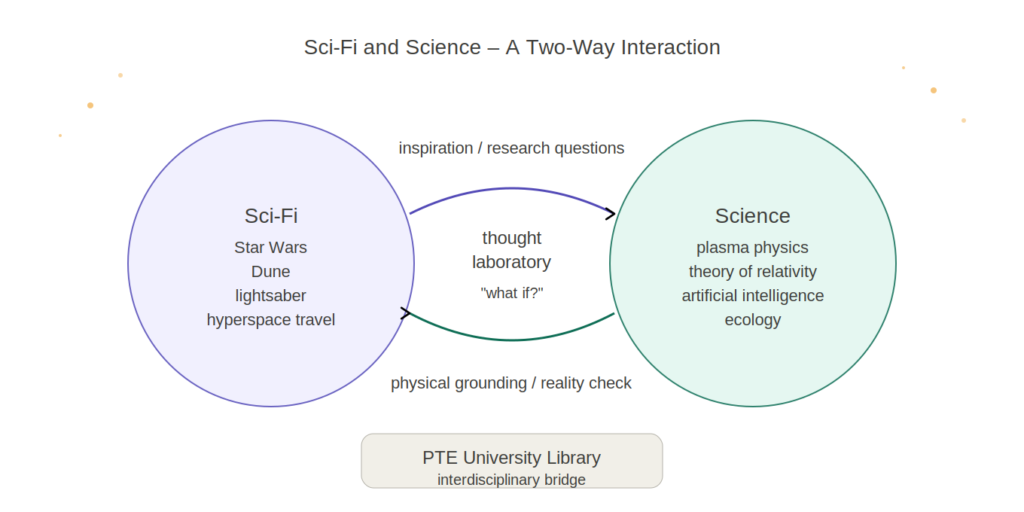
Overall, it can be said that the relationship between science fiction and science is not one-directional. Science does not merely inspire fiction; fiction is also capable of opening new directions for science. The worlds of Star Wars and Dune represent two different yet complementary examples of this interaction.
The only remaining question is this: how many of the scientists of the future drew inspiration from these stories? And perhaps even more importantly: how open are we, as readers and viewers, to asking new questions while balancing on the border between imagination and science?
Recommended Videos and Media Content
For those who would like to learn more about the physics of the impossible, we recommend Gábor Lente’s accessible lectures and video content, as well as various scientific discussions and articles.
- Gábor Lente’s YouTube channel
- Science in the Universe of Dune
- Lecture: Science in the Universe of Dune
Podcast Discussions
- Science as a Cure for Fear – A Conversation with Gábor Lente
- “Physics Is Most Similar to Building with LEGO” – A Conversation with Physicist György Tóth
- The Long Road from Legal Studies to the Stars – A Conversation with Space Lawyer Dr. Zsófia Bíró
Articles and Guides
- AI in Academic Publishing: What Researchers Need to Know
- Publishing with AI Assistance: Paperpal User Guides
- More Efficient, More Accurate, More Transparent: Perplexity AI as a Tool for Scientific Research
Sources and Recommended Reading
- Carsten, P. W. (2017): The Physics of Star Wars: Introducing Accelerator Science
- Grazier, K. R. (2017): The Science of Dune
- Herbert, F. (1965): Dune
- Kaku, M. (2008): Physics of the Impossible
- Kaku, M. (2011): Physics of the Future
- Lente, G. (2019): The World of Dune Through the Lens of Science
- Clifton, J.: The Science Behind Star Wars
- Ádám Nagy (ed.): Beyond Space-Time: Studies on Our Favorite Universes
Leave a Reply