
Note-taking is a key part of any learning process, whether it’s for college classes, exam prep, or professional training. Choosing the right technique not only makes learning more effective, but also helps to organize information, deepen understanding, and retain it in the long term. Let’s take a look at the most well-known and effective note-taking methods: what they are for, when to use them, and how they differ from each other.
Cornell method – if your mind is in chaos, this will bring order
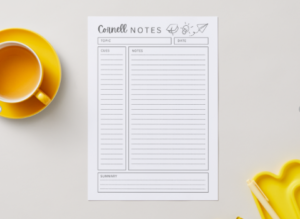
The Cornell note-taking technique is one of the best known and most widely used methods, developed specifically to support effective learning. The essence of this technique is to divide the page of the notebook into three distinct sections, making it easier to remember the course material and recall it later in a much clearer way.
How is it structured?
- Notes: This is the largest section, located on the right-hand side. This is where you can write down all the important information you hear/read during the lecture or while studying. This section is for noting down detailed content.
- Keywords: This is a narrower column on the left-hand side. Key concepts, definitions, dates, or questions are listed here. This helps us quickly review the main points and recall the material more easily.
- Summary: Located at the bottom of the page. A short, compact summary highlighting the most important lessons learned from the page.
Our brains prefer answering questions to “absorbing” information. When you write questions in the keyword column, your brain automatically starts searching for the answer—even when you’re not actively studying. That’s why this method works so well during exam season.
Recommended for students who like a clear, organized structure and who find it important that their notes are easy to review.
Mind map – visual organization for creative thinkers
If you lose focus after five minutes of linear note-taking, it’s not your fault. It’s simply not how your brain works.
A mind map olyan, mint egy vizuális gondolkodási játszótér: színek, nyilak, kapcsolatok. Az agyunk képekhez és történetekhez kötődve emlékezik a legjobban, ezért sokszor egy rajz vagy szín többet ér, mint egy fél oldal szöveg.
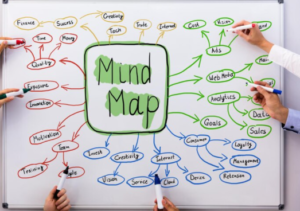
A mind map is like a visual playground for thinking: colors, arrows, connections. Our brains remember best when linked to images and stories, which is why a drawing or color is often worth more than half a page of text.
A mind map is like a tree growing out of the center of the page, with each branch representing a new idea. This not only helps you organize the material, but also makes it much easier to understand the connections between ideas.
You don’t need to be able to “draw beautifully.” The important thing is that it makes sense to you. A messy but personal mind map is much more effective than a perfect but unfamiliar note.
How is it structured?
- The main topic or key concept is placed in the center of the page.
- From there, branches extend out, representing the main sections related to the basic topic.
- The branches can be further broken down into smaller units, gradually building up the complete picture.
- The use of colors, icons, drawings, and short keywords aids visualization and memory.
It is useful for summarizing course material, planning projects, or quickly reviewing large amounts of information. Its hierarchical structure makes it easy to navigate. It is a creative tool that supports associations and idea generation. If you take visual notes, the group study rooms in the university library are perfect for creating mind maps together.
Digital notes – Faster than the lecturer – but a little self-control doesn’t hurt
Taking notes on a laptop is convenient. So much so that sometimes we type without thinking, and then before the exam we realize that we have no idea what we wrote down.
Your brain can be a bit misleading here: just because it’s written down doesn’t mean you know it. That’s why it’s crucial to rephrase, abbreviate, and summarize your digital notes – otherwise, they’ll just remain a nice but useless document.
Tip: If you write a 3–4 line section at the end of a note titled “What should I remember from this?”, it will make it much easier to recall during the exam.
When is it recommended?
- When you need to take notes quickly,
- when you need to review many slides in a short period of time,
- for presentations,
- for building long-term databases: so that all notes are available in one place in a searchable format.
Tips for good digital note-taking
- Use the right app!
For digital note-taking, it is worth choosing an app that offers a well-organized interface, supports multiple formats (text, images, links, PDF), and allows you to organize your notes into folders, pages, or tags. It is advantageous if the app supports cross-referenced notes, so that different topics can be easily linked, and if it can be synchronized across multiple devices.
- Choosing a device
- Laptop: for fast typing and large amounts of material.
- Tablet + stylus (e.g., iPad + Apple Pencil): if you like to write by hand, draw, or make diagrams.
- Phone: for short notes and quickly jotting down ideas on the go.
- Note-taking tips/tricks
- Use tags and folders! – This will make everything easy to find.
- Color or highlight keywords! – This helps your memory visually.
- Insert images and links! – This way, you don’t have to search for separate files.
- Write a short summary at the end of each note! – This is invaluable when preparing for exams.
- Synchronize your devices! – This way you can access your notes anywhere, whether from your phone or computer.
- Use the search function! – The biggest advantage of digital notes is that you can find what you’re looking for in seconds.
- Organize from time to time! – Delete the excess, create a logical structure!
Digital note-taking is also supported by the library’s infrastructure, such as Wi-Fi, access to online databases, and the possibility of borrowing e-devices. This allows you to insert library resources directly into your notes and build a searchable knowledge base. Overall, digital note-taking is not only fast and practical, but also helps you build a transparent knowledge base that you can easily refer back to at any time.
Charting method – tabular comparison
This is the method we really start to appreciate when we see questions like this on exams: “Compare…”
When we see the information side by side, it is much easier to recognize the essential differences.
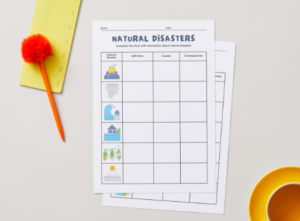
The essence of charting, or tabular note-taking, is that you organize the material into categories and then place them side by side in a table. For example, one column could contain the concepts, the next the definitions, then the examples, and finally the advantages and disadvantages.
How is it structured?
- Columns: each column represents a category (e.g., concept, definition, example).
- Rows: each row is a topic or model that you are comparing.
- Clarity: the table helps you quickly see similarities and differences.
When is it recommended?
- For comparative subjects: for example, comparing marketing models, psychological theories, or philosophical trends.
- For historical periods: it is easy to see how different periods differ (e.g., economy, politics, culture).
- For statistical or research data: it is much easier to organize and analyze numbers in tabular form.
Feynman method – note-taking and learning in one
The Feynman method is named after Nobel Prize-winning physicist Richard Feynman, who was famous for his ability to explain even the most complex theories in a simple and understandable way. This technique is not a classic form of note-taking, but rather a learning strategy, the essence of which is to write down or explain the material as if you were explaining it to a small child!
How do we use it?
- Choose a topic! – Write down the concept, theory, or topic you want to understand at the top of the page or at the beginning of your notes!
- Explain it simply! – Write everything down as if you were explaining it to a layman or a child! Avoid complicated technical terms and use examples from everyday life!
- Identify the gaps! – If you get stuck or can’t put it into simple terms, it means you don’t fully understand it yet. In this case, go back to the source (textbook, notes, lecture) and clarify the section!
- Simplify and organize! – Rewrite the explanation in an even more understandable form! Use analogies, drawings, and examples!
- Say it out loud! – This method is most effective when you explain it verbally, either to yourself or to someone else. This helps to consolidate your knowledge and reveal any gaps.
This method is particularly useful when you encounter complex, complicated theories—whether they be physical laws, economic models, or philosophical concepts—as it forces you to express yourself simply and clearly. It is also a great tool before exams, as it not only ensures that you “know” the material, but also that you can express it, which can be crucial during testing.
This technique is recommended for those who like to learn through explanation and enjoy trying to articulate what they have learned aloud or in writing. It can be particularly useful for students who often feel that although they understand the material, they are unable to explain it clearly. It is also an ideal choice for those who have to demonstrate their knowledge orally in exams, as the Feynman method prepares them precisely for this: to be able to convey the knowledge they have acquired in a clear, logical, and confident manner.
How to decide which note-taking method is best for you?
The key to choosing is recognizing your own learning style. Think about which aspect is most important to you:
- Structure and logic → Cornell
- Creativity and visuality → Mind map
- Speed and organization → Digital notes
- Comparison and analysis → Charting
- Deep understanding and explanation → Feynman method
The bottom line: a good note-taking method is not a rule, but a tool. Choose one that makes it easier to understand, supports your memory, and adds something to your learning experience! If you experiment consciously, over time you will develop your own unique system that really works.
Leave a Reply